



At construction sites, quarries, and industrial facilities, the movement of heavy vehicles is a critical part of daily operations. Every truck entering or leaving the site must follow specific procedures, which may include access control, load weighing, and wheel washing.
When these tasks are managed through separate, standalone systems, the movement of vehicles can become more complex—impacting transit times and the organization of internal traffic.
In this context, integrated wheel-washing and weighing systems can be a strategic choice.
Determining the value of such a system goes beyond just the initial capital cost. To decide whether an integrated solution is truly the right fit for a specific site, five key criteria must be considered.
The first criterion: analyzing the actual flow of vehicles

The starting point is the number of vehicles passing through the site daily, along with how entry and exit points are organized.
A facility with low daily traffic volume has very different requirements compared to a quarry or a logistics center characterized by a constant flow of heavy vehicles.
Therefore, the integration of vehicle washing and weighing systems must be evaluated based on traffic frequency, peak periods, and the specific characteristics of the vehicles.
If the layout is not properly sized, there is a risk of creating a bottleneck precisely where control operations are concentrated.
Conversely, a design based on actual traffic flows can help reduce wait times and ensure a more orderly movement of vehicles.
The second criterion: evaluating operational timelines and productivity
The time required to complete entry and exit operations is one of the most critical factors when evaluating an investment.
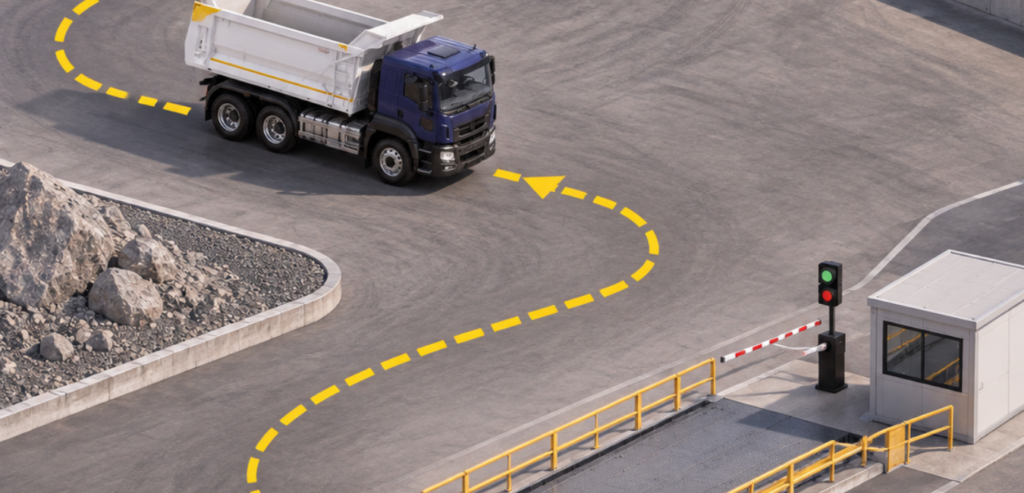
When weighing and washing take place at different locations, vehicles may need to travel extra distances, perform additional maneuvers, or wait for specific stations to become available.
A well-designed integrated system can streamline the route and improve the coordination of these operations.
However, this benefit must be quantified. It is necessary to compare current processing times with those projected after the implementation, while also accounting for potential queues and peak traffic periods.
Saving just a few minutes per vehicle can have a significant impact when multiplied across a high volume of daily transits.
Ultimately, the efficiency of an investment lies in its ability to boost productivity without compromising the accuracy of the weighing process or the effectiveness of the washing operation.
The third criterion: considering the overall costs of the system

The purchase price represents only a portion of the true cost of an integrated washing and weighing system.
An economic assessment must also account for water and energy consumption, maintenance requirements, the management of contaminants, and any modifications needed to adapt the operational area.
A system that appears affordable initially may become more expensive over time if it requires frequent repairs, consumes large quantities of water, or causes bottlenecks in vehicle traffic.
For this reason, it is useful to consider the total cost of ownership—factoring in not just the initial investment, but also the operating expenses expected throughout the system’s service life.
Closed-loop filtration plays a significant role, as it allows for the recovery and reuse of wash water, thereby reducing the need for fresh water resources.
The fourth criterion: verifying integration with existing infrastructure
The introduction of an integrated system does not always require the complete replacement of existing infrastructure.
Many industrial sites have weighbridges, wheel-washing systems, or water treatment circuits that are still functional but no longer fully suited to current operational requirements.
Before investing in a new solution, it is therefore important to assess the possibility of integrating or upgrading existing components.
A retrofit project can be an attractive alternative—provided that technical conditions allow for it—as it enables the utilization of existing structures while minimizing the need for more invasive interventions.
System compatibility must be carefully verified, particularly with regard to weighing accuracy, installation conditions, water management, and traffic safety.
The goal is to establish a coordinated process in which each component maintains the required level of performance without interfering with the others.
The fifth criterion: measuring return on investment

The final criterion concerns the economic value that the system can generate over time.
To evaluate the return on investment for a washing and weighing system, it is necessary to compare the costs of the solution against the expected operational benefits.
Factors to analyze include reduced turnaround times, potential savings in resource consumption, a decreased need for extraordinary maintenance, and more efficient access management.
Operational continuity also plays a significant role. A reliable, properly sized system can help minimize slowdowns and improve the organization of operations.
Therefore, the economic return should not be assessed based on a single parameter, but rather by considering the overall impact of the investment on the site’s functioning.
Washing and weighing: the importance of integrated design

The five criteria highlight a fundamental principle: integrating two operations does not automatically result in a more efficient process.
The outcome depends on the ability to design a solution that is consistent with traffic flow, available space, control requirements, and the specific characteristics of the facility.
Tecnoter Group addresses the efficiency of washing systems by considering the relationship between vehicle flow, water management, filtration, and operational continuity.
In a project that also includes weighing, these elements must be evaluated alongside the technical and metrological requirements of the measuring system, in order to identify a configuration that is truly suited to the site’s needs.
Investing in an integrated vehicle washing and weighing system can be an opportunity to improve access organization and streamline the management of heavy vehicles.
However, such a decision must be based on a concrete analysis. Traffic flows, operational timelines, management costs, compatibility with existing infrastructure, and return on investment are all closely interconnected factors.
Evaluating these elements holistically allows you to move beyond a perspective focused solely on the initial price, enabling the identification of a solution that generates long-term value.
Are you wondering whether integrating washing and weighing systems would be beneficial for your facility?
Every site has unique operational characteristics. Before making an investment, it is essential to understand how vehicles are currently managed and where there is room for improvement.
Contact Tecnoter Group to analyze your washing system, access flows, and the potential for integration with your existing infrastructure. A targeted technical assessment is the first step toward making an investment that is efficient, sustainable, and aligned with your actual operational needs.