


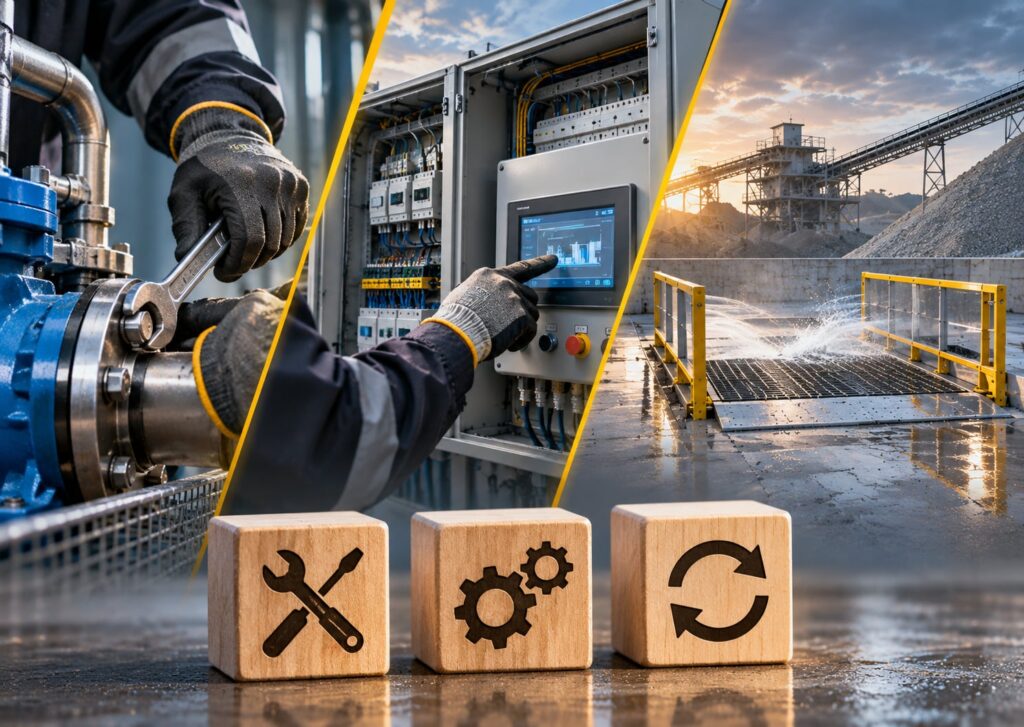
When a system shows a loss of efficiency, the first question often concerns the cost of intervention. How much will it cost to repair? Is a retrofit worthwhile? Is it time for a replacement?
These are important questions, but making a truly effective decision requires one crucial piece of information: what is the cost of having the system out of service?
The cost of system downtime is not the same as the cost of maintenance. An interruption can slow down the production process, tie up personnel, immobilize equipment, and necessitate extraordinary measures. If the problem recurs over time, even relatively short periods of downtime can add up to a significant operational cost.
Before deciding on a course of action, it is therefore useful to shift your perspective: instead of just evaluating the cost of repairing the system, consider the cost of continuing to operate under the current conditions.
Using historical data to understand the cost of plant downtime
Before deciding whether to take action, it is useful to reconstruct the system’s performance over time.
One should not focus solely on the most recent failure; rather, the overall trend reveals whether the issue is an isolated incident or a structural decline in reliability.
The frequency of interventions, hours of downtime, and the time required to restore the system to normal operating conditions help build a more realistic picture. These factors must be considered alongside the impact on operational activities.
For instance, if a washing system breaks down, which operations are slowed down? How many vehicles are left waiting? Is it necessary to implement an alternative procedure? How much personnel is involved?
Translating these effects into time and costs makes it possible to assign an economic value to the downtime and compare it against the investment required to improve the system.
Measuring inefficiencies in addition to failures
Maintenance history tells only part of the story. Another factor to consider is how performance evolves over time.
In washing and filtration systems, for example, an increase in water consumption, more frequent sludge handling, or a growing need for cleaning can all indicate that the system is no longer operating under optimal conditions.
The same applies to operational runtimes. If a cycle takes progressively longer, this can impact the flow of materials, leading to delays that—when multiplied across numerous daily operations—become economically significant.
Collecting this data allows you to move from a mere perception of inefficiency to its actual measurement. And it is precisely when a problem becomes measurable that you can accurately compare different potential interventions.
Maintenance, retrofit, or replacement? The choice starts with data
When faced with an inefficient system, a complete replacement is not automatically the best solution. Conversely, continuing to carry out minor repairs can become uneconomical as the frequency of breakdowns and indirect costs continue to rise.
Analyzing the cost of system downtime helps determine which scenario offers the greatest value in the medium to long term.
If the main structure remains adequate, a retrofit can be an effective way to upgrade critical components, improve the hydraulic circuit, or integrate more efficient filtration systems. In other cases, targeted maintenance may suffice. However, when performance and reliability are no longer compatible with operational requirements, it may be worth considering a more comprehensive solution.
The decision should be based on the balance between the investment required, the expected benefits, and the cost of maintaining the current situation.
In washing and filtration systems, downtime affects the entire process.
An industrial washing system does not operate in isolation. It is interconnected with the flow of media, water management, filtration, and the treatment of contaminants.
If one part of the process loses efficiency, the consequences can extend to the entire cycle. Inadequate filtration may lead to more frequent maintenance; a sub-optimal hydraulic circuit can impair washing performance; and longer processing times can cause bottlenecks in the access area.
For Tecnoter Group, analyzing a facility means examining the system as a whole. The goal is not merely to identify a component that needs replacing, but to understand the root cause of any inefficiency—and to determine which intervention will create the optimal balance between reliability, costs, and operational continuity.
From data to preventive maintenance

Knowing the cost of plant downtime also makes it possible to change how maintenance is planned.
If an unscheduled interruption has a significant impact, it may be more cost-effective to take action before a failure occurs. Preventive maintenance allows tasks to be scheduled for less critical periods, reducing the risk of being forced to intervene during production peaks.
The data collected thus becomes a decision-making tool: it helps identify recurring issues, plan investments, and determine when a retrofit might be more advantageous than constantly managing emergencies.
What does it cost you today not to take action?

If recurring downtime, increasing maintenance requirements, or underperformance are impacting your operations, a technical analysis can help you pinpoint exactly where costs are being incurred.
Contact Tecnoter Group to assess the condition of your equipment and determine whether maintenance, a retrofit, or a new system could improve reliability and efficiency. Basing your decisions on data ensures that you invest where interventions will generate the greatest operational value.